
If you searched for the federal tax credit HVAC 2025 Texas homeowners could claim, the key date was December 31, 2025: qualifying equipment had to be placed in service by then, and the federal Energy Efficient Home Improvement Credit was claimed on the tax return for that installation year.
Talk with Garland Heating and Air Conditioning about your next HVAC installation and ask for a written equipment and installation quote for your DFW home.
Quick answer: Under the statutory 2025 rules, a qualifying heat pump could receive a credit of 30% of eligible costs, up to $2,000. A qualifying central AC, natural gas furnace, or boiler generally fell under the $1,200 annual category, with a $600 limit for each eligible item. The equipment had to meet efficiency rules and have a qualified manufacturer identification number, or QMID.
For budgeting context before comparing incentives, review Garland Heating and Air Conditioning’s AC installation cost factors guide for DFW homeowners.
The federal HVAC tax credit in 2025 was part of the Energy Efficient Home Improvement Credit under Section 25C. The credit was available for qualifying equipment placed in service in an existing home in the United States. It was not a general discount on every replacement system, and buying equipment alone was not enough. The model, efficiency rating, installation date, and documentation all mattered.
| HVAC equipment | Potential 2025 credit | Key qualification point |
|---|---|---|
| Air-source heat pump | Statutory credit: 30% of eligible cost, up to $2,000 | Must meet the applicable 2025 efficiency requirements and be produced by a qualified manufacturer. |
| Central air conditioner | Statutory credit: 30% of eligible cost, up to $600 | Must meet the applicable CEE efficiency tier for the year placed in service. |
| Natural gas, propane, or oil furnace or boiler | Statutory credit: 30% of eligible cost, up to $600 | Must meet the applicable efficiency requirements and documentation rules. |
| Geothermal heat pump | Separate residential clean energy credit rules | Review the Section 25D rules because geothermal equipment is not counted in the standard $2,000 heat pump limit. |
The IRS summary of the Energy Efficient Home Improvement Credit explains the annual limits, eligible property, home requirements, and nonrefundable nature of the credit. For a local equipment conversation, Garland Heating and Air Conditioning provides AC installation and replacement throughout the Dallas-Fort Worth area.
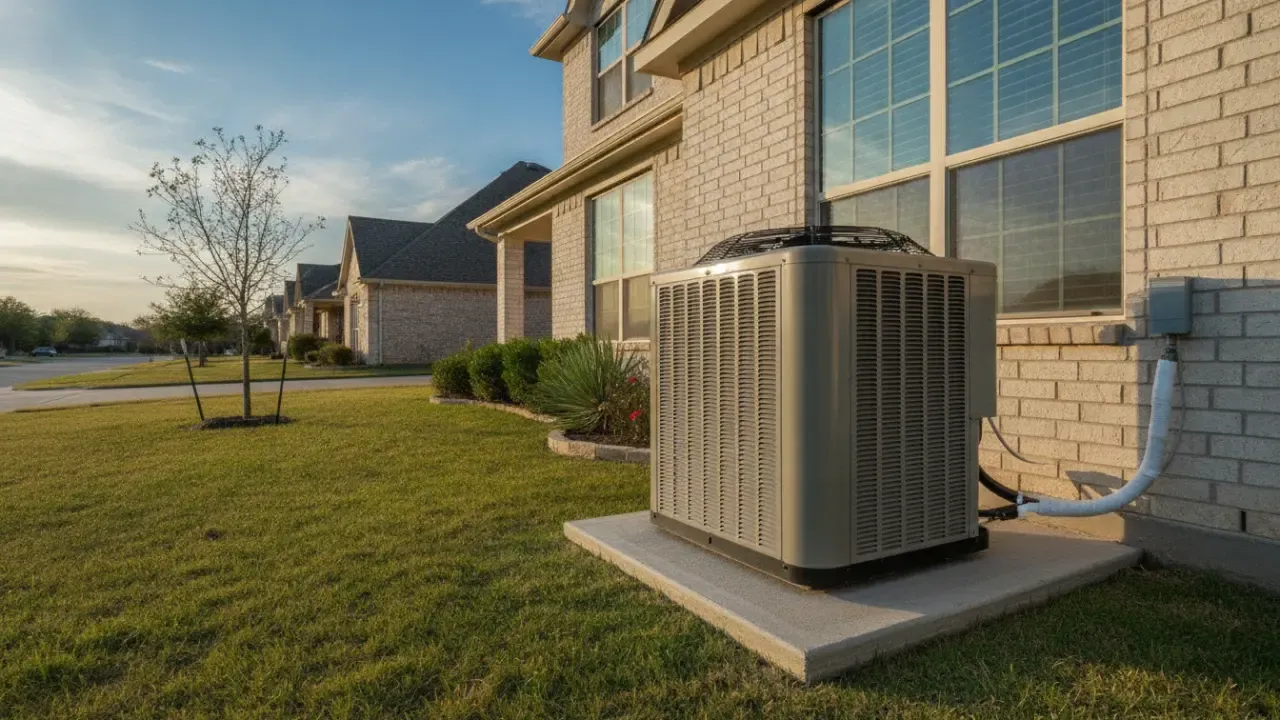
A qualifying 2025 heat pump could provide a statutory credit equal to 30% of eligible costs, up to $2,000. The amount was not automatically $2,000. For a statutory example, 30% of $5,000 in eligible costs would reach the $1,500 level, while a higher qualifying cost could be limited to the $2,000 annual maximum.
ENERGY STAR reported updated 2025 requirements for air-source heat pumps. Eligible products were recognized as ENERGY STAR Most Efficient and followed one of two paths: a cold-climate path or a cooling-dominated and dual-fuel path. A DFW homeowner should not rely on a product name or a sales description alone. Use the model number and the current ENERGY STAR heat pump tax credit guidance to confirm the equipment.
Keep the final proposal, model numbers, installation invoice, and manufacturer documentation together. Ask the installing contractor to identify the exact equipment being quoted before the project begins. This helps separate a qualifying system from a similar-looking model that does not meet the required efficiency tier.
For homeowners comparing system types, Garland Heating and Air Conditioning also explains its heating installation and replacement services, including furnace and heat pump options for North Texas homes.
Ask Garland Heating and Air Conditioning which equipment details belong in your written quote before comparing a potential federal credit with the full installation scope.
Yes, some high-efficiency central AC systems and natural gas, propane, or oil furnaces and boilers could qualify for the 2025 credit. Under the statutory category, these items were in the $1,200 annual category, and each qualifying central AC or furnace was generally limited to a $600 credit. The equipment still had to meet the applicable federal efficiency standard for the year it was placed in service.
ENERGY STAR listed 2025 efficiency thresholds for central air conditioners. Split-system central AC equipment needed SEER2 of at least 17.0 and EER2 of at least 12.0. Packaged central AC equipment needed SEER2 of at least 16.0 and EER2 of at least 11.5. These ratings were not interchangeable, so ask for the complete matched system details rather than relying on the outdoor unit rating alone.
The ENERGY STAR central air conditioner tax credit page is a useful starting point, but the IRS rules control the tax filing. A contractor can help identify equipment and preserve project documentation, while a tax professional should confirm the credit for your specific return.
A furnace did not qualify simply because it was new or efficient. The system had to meet the applicable requirements, and the taxpayer needed the manufacturer’s identification information required for 2025. Garland Heating and Air Conditioning can discuss replacement options through its DFW heating service, but it cannot determine a homeowner’s tax liability.
Homeowners claimed the 2025 Energy Efficient Home Improvement Credit on Part II of IRS Form 5695. The credit belonged to the tax year when the property was installed or placed in service, not necessarily the year when it was ordered or paid for. The IRS also treated this as a nonrefundable credit, so it could reduce tax owed but could not create a refund beyond the taxpayer’s qualifying liability.
Use the IRS Instructions for Form 5695 for 2025 to review the filing details. The instructions explain that the credit was available only for property placed in service through December 31, 2025, and that the QMID requirement applied to specified property placed in service during 2025.
Important: This article is general educational information, not tax advice. Rules can change, and a tax professional should review your receipts, tax liability, home use, and equipment eligibility before you file.
Possibly, but a utility rebate was separate from the federal tax credit and depended on the customer’s service territory, equipment, program funding, contractor participation, and application timing. A rebate was not guaranteed merely because an HVAC system met a federal tax-credit standard.
For example, the 2025 Oncor Home Energy Efficiency Standard Offer Program manual described incentives for approved service providers and included high-efficiency central AC and heat pump measures. It also stated that funding and deadlines were limited. A homeowner should check current availability rather than assume a 2025 program remains open.
Texas’s State Energy Conservation Office is also developing the federal HOMES and HEAR rebate programs. The Texas Comptroller’s IRA rebate page is the best place to check state updates. As of its August 21, 2026 update, Texas said those rebates were not yet available and were still in planning and design. That status is separate from utility programs and from the expired 2025 federal tax-credit window.
Request a customized HVAC installation quote from Garland Heating and Air Conditioning and ask which equipment details and records will be included in the proposal.
A tax credit should be one part of the replacement decision, not the reason to install a system that does not fit the home. A properly sized system, matched indoor and outdoor equipment, ductwork condition, electrical requirements, and installation quality all affect comfort and performance.
Garland Heating and Air Conditioning has served the Dallas-Fort Worth area since 1952, with residential and commercial HVAC installation, replacement, repair, and maintenance services. For planning questions, review the DFW HVAC financing and budgeting guide and then contact the team for a quote based on the home and equipment requirements.
A qualifying system was generally eligible for a tax credit, not a blanket deduction. The 2025 Energy Efficient Home Improvement Credit applied only to eligible equipment that met the applicable requirements and was placed in service by December 31, 2025. Use Form 5695 and confirm the details with a tax professional.
Eligible categories included qualifying air-source heat pumps, central air conditioners, and natural gas, propane, or oil furnaces or boilers. Each model had to meet the relevant efficiency rules and manufacturer documentation requirements. A new system was not automatically eligible because it was high efficiency.
Some qualifying HVAC property categories allowed a taxpayer who used the home as a residence, including a renter who made the eligible improvement. The exact rule depended on the property and expense. Review the IRS guidance and ask a tax professional before filing.
It may have been possible, but the utility program controlled its own eligibility and application rules. Confirm whether the rebate was open, whether pre-approval was required, and whether the program allowed the same project to receive other incentives.
Homeowners used Part II of IRS Form 5695, Residential Energy Credits, for the Energy Efficient Home Improvement Credit. The form was filed with the federal return for the year the qualifying property was installed or placed in service.